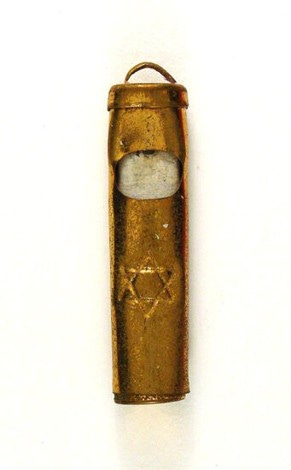
Shema Israel: Deuteronomy 6:4-9
by Kristen West McGuire
For the next year, My Secret is Mine newsletter will be centered on the autobiography of Dr. Edith Stein, Life in a Jewish Family. Canonized in 1998, she is now known by her Carmelite name of St. Teresa Benedicta of the Cross, co-patroness of Europe. Many apostolates today have St. Teresa as their patroness, including My Secret is Mine. This series will explore the Jewish roots of the Catholic faith found in the Old Testament and Magisterial teachings. All of our content will explore the themes of conversion, family relationships, and Jewish heritage in the life of Edith Stein.
Deuteronomy 6:4-9
4 Hear, O Israel, the Lord our God is one Lord. 5 Thou shalt love the Lord thy God with thy whole heart, and with thy whole soul, and with thy whole strength.
6 And these words which I command thee this day, shall be in thy heart: 7 And thou shalt tell them to thy children, and thou shalt meditate upon them sitting in thy house, and walking on thy journey, sleeping and rising. 8 And thou shalt bind them as a sign on thy hand, and they shall be and shall move between thy eyes. 9 And thou shalt write them in the entry, and on the doors of thy house.
Context:
Tradition states that the book of Deuteronomy was written by Moses between 1400-1200 BC. In the New Testament, Jesus quotes this Old Testament book more than twenty times. Deuteronomy serves as the key explanation of the covenant of the Jewish people with YHWH, the one God. It is structured similarly to ancient Near East treaties (suzerainties) that outline the terms of a power relationship with an earthly sovereign. However, in this case, the sovereign is our heavenly Father.
Translation:
There is disagreement between Jews and Christians about the Hebrew word for “one” in this verse. The word is אחד (echad) which can connote a complex unity, in addition to the number one. In comparison, the word, יחיד (yechid) means one alone, or the only one. It is easy to understand, therefore, why the Christian formulation of the Trinity (Father, Son and Holy Spirit) is unacceptable to Jewish monotheism. And, this covenant remains to this day. Christians believe that we are included in this covenant through faith in Jesus Christ as the Messiah.
Vocabulary:
שְׁמַע (shemaʿ) “Hear” connotes attention that leads to obedience.
יְהוָה אֶחָד (YHWH ʾecḥad) “The LORD is one.”
מְזוּזָה (mezuzah) “doorpost” (See below.)
Meditation: The first line of this Bible verse is the first prayer that a Jewish child would learn. It is also supposed to be the last prayer that a Jewish person would pray before death. The video below includes the full prayer chanted in Hebrew. Christians will be very familiar with these verses in the Bible, because Jesus specifically reminds us of the Shema (Mark 12:29-30).
The formulation of this statement of the relationship between God and Israel is received. It is not a creed like the Apostles Creed, nor is it a list of the commandments. The verse says, “Hear, O Israel.” Not, “Believe this.” Not, “Fear the Lord and you will be saved.” Rather, “Hear and receive this special relationship with the God who loves you.” It was a personal relationship with a God of love to Whom Israel was tasked to be obedient.
After the Holocaust, the story is told that various rabbis visited orphanages seeking Jewish orphans. When the rabbis sang the Shema Israel, those children who were Jewish reacted or even chimed in. The Shema is a prayer that Christians can and should echo, especially in our daily lives. Each day, we can pray with our Jewish brothers and sisters, “Shema Israel…” Thou shalt love the Lord thy God with thy whole heart, and with thy whole soul, and with thy whole strength.
How to chant the Shema Israel prayer

What is a mezuzah?
Mezuzah literally means “doorpost,” and it refers to a small parchment scroll upon which the Hebrew words from Deuteronomy 6:4-9 and Deuteronomy 11: 13-21 are handwritten by a scribe. Mezuzah scrolls are rolled up and affixed to the doorposts of Jewish homes.
Some Jewish people believe that the mezuzah also protects the home, and they touch the mezuzah upon entering and exiting their homes, as a reminder of God’s care for them.